Sustainability at Peddie: Practice + Purpose
With the recent appointment of a dedicated sustainability coordinator, Peddie is poised to build on its commitment to environmental stewardship.
In the classroom and on the stage, in the dining hall and at the athletic center, Peddie has long taken steady, Earth-forward strides. Then, it took a leap.
Nika Blank ’16, who joined the faculty as a science teacher in 2022, was recently named Sustainability Coordinator and also serves as PEST (Peddie Environmental & Sustainability Team) supervisor. Her role includes helping to identify — across curriculum, operations and community life — what the school is doing well, along with opportunities for upscaling efforts.
“Sustainability has been important to Peddie over the years,” said Head of School Jim Hamilton. “Look at the solar work we’ve done, the thoughtful work that we do in PFS (Peddie Food Service), our academic curriculum. Having someone who is able to create a framework for that work is critically important, and it feels like the right time to do that.”
At the Peddie board meeting this past winter, the Buildings and Grounds Committee agreed to integrate green principles within projects currently in motion, as well as further down the road.
“It’s starting to get into the conversation,” said Blank. “We’re looking at how to gather more data about where we are so we can set goals, then formalize those goals to span across everything.”
Why does practicing sustainability matter for Peddie?
“First and foremost, our mission is to guide students toward the highest quality of citizenship,” said Blank, “supporting them in developing skills that make them leaders in the world. We’re thinking about our impact — not only on our communities, but on the environment and the planet. It’s about creating a more organized effort where it’s really embedded into the institutional values.”
Hamilton knows taking considered steps, however small, will help mold Peddie students and employees into “great stewards of the environment.”
“There are little things that send big messages about what an institution believes,” he said. “Part of what I hope we get in this building-block phase is a set of guidelines, that we think about being sustainable and our practices. And as you layer them on top of each other, they’re going to make a big difference.”
What’s Working … And Fueling Momentum
One of Peddie’s biggest sustainability success stories takes place three times a day: in the dining hall, where PFS Chef Jeremy Stahl has embraced with fervor good eating and green principles.
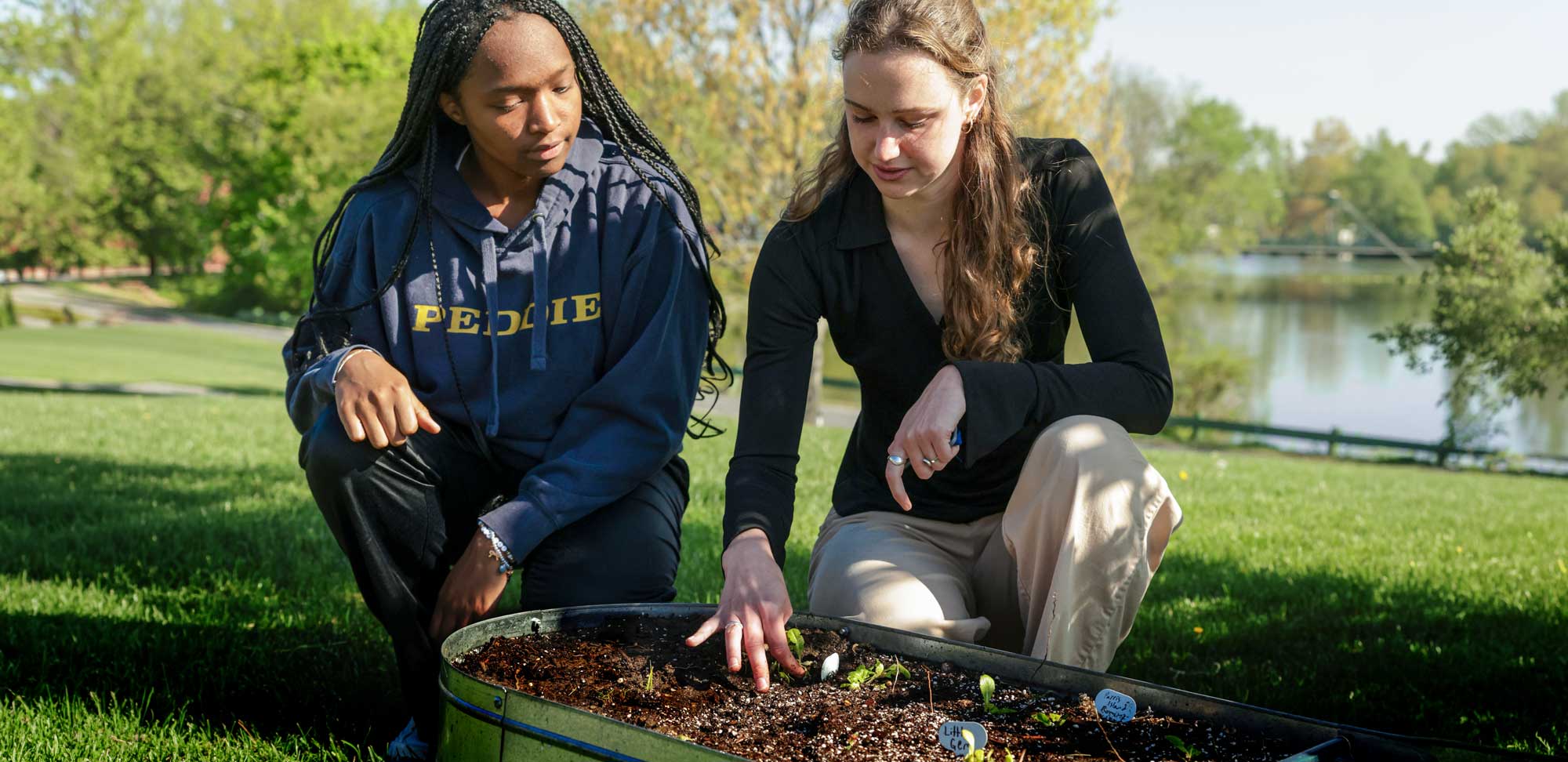
Stahl sources local produce as often as possible, with nearly all of it from the tristate area during the growing season. And last fall, he was able to source it without even leaving campus: Earlier in the year, PEST members told him they were planning a fall garden, and asked him what kind of produce he would be willing to serve in the dining hall. He replied that he would use anything they grew.
The club planted and harvested cold-tolerant spinach, lettuce and arugula. In the salad bar, Stahl proudly labeled it “Peddie greens.”
“Everybody was eating it,” said Blank. “They ate all of it. That was a really cool moment for the students, to see the food they grew, the seeds they had planted, ending up in the dining hall.”
Of all PEST does in the Peddie community to encourage action on topics like recycling, Club President Olivia Lu ’27 is most proud of its composting partnership with PFS. PEST regularly educates the school community about composting via its newsletter and training on what’s compostable and what isn’t. And every day after meals in the dining hall, Peddie students and employees drop their food scraps into communal waste bins. Contents go to feed pigs or, once reduced to nutrient-rich compost, to fertilize crops.
“Composting is such a big part of our daily culture and routine,” said Lu. “It’s so easy to make this change, and it’s really been impactful.”
“It’s a part of the culture in the dining hall for all students and faculty,” said Blank. “2025 was our biggest year yet. We diverted 29.15 tons of organic material from landfills.”
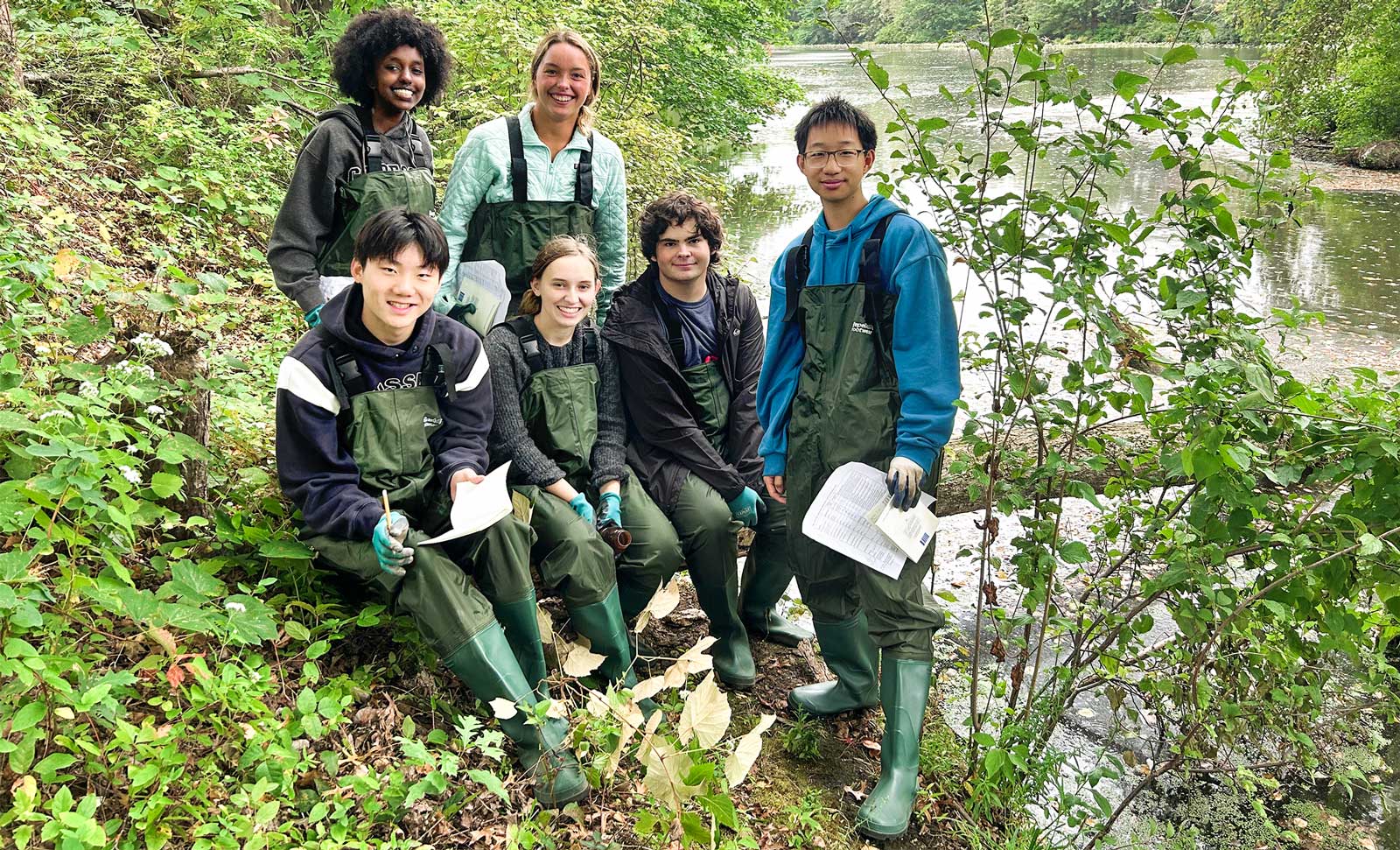
Blank’s Field Ecology class is another example of a big swing that’s reaping rewards for Peddie, as well as the environment. The inaugural course was held last fall. On a macro level, its goal was for students to acknowledge and deepen their relationship with the natural world, with campus and its immediate surroundings as terra nova.
But that’s best begun on a micro level, which students tackled with gusto. They learned to identify native and non-native plants, the implications of both on animal life and to recognize local birds and birdsong.
“We were outside every single day of our class,” said Blank. “Students even asked if we could have class earlier (at 6:30 a.m.) so we could hear more of the birds. So we got up early, went out and listened. Then we did a unit on wildlife, specifically mammals. We set up camera traps around campus and have some great footage of foxes, raccoons, possums.
“The students were so excited,” she continued. “We’re living on a campus that seems like it’s not very natural, right by the turnpike. But we have tons of animals that actually roam through campus. It’s not just something that’s ‘out there.’ It’s right here. And in an age where technology and social media are always pulling the kids’ attention, the class was a way for them to savor being outside and observing what’s going on around them in their physical surroundings.”
After the Field Ecology students surveyed Peddie Lake and its periphery, they determined that it fulfilled the National Wildlife Federation’s criteria for an unmaintained area that provides wildlife with food, shelter and water. Their work earned Peddie a certified wildlife habitat designation.
Challenges, Opportunities And Tradeoffs
When it comes to dialing up sustainability efforts across campus, Assistant Head of Finance and Operations Sanjeev Puri and Director of Building Services Mike Shanko agree that smarter, more efficient energy usage is at the top of their list … and that comes with a mindset shift.
“We could do better with some level of education and acknowledgement of the overall magnitude of what this campus consumes on an annual basis,” said Puri. “Responsible behaviors would absolutely lead to reduction in energy consumption across campus. The more square footage we are putting in, the more our energy footprint is growing, and it just doesn’t seem to stop.”
Nika Blank’s Field Ecology class surveys Peddie Lake.
Peddie can already boast several sustainable, energy-efficient feathers in its cap. It was one of the first high schools, in 2011, to embrace a big push into solar energy, and the solar panels in the athletic center parking lot generate about 38 percent of campus energy. Since the goats continue to enjoy the grass in the athletic center’s steeply sloped detention basin, grounds staff can mow the area less frequently and take fewer risks with its equipment. At every opportunity, building services staff have been switching out fluorescent bulbs for longer lasting, and thus more economical, LED bulbs. And EV chargers are also on the horizon.
Sustainability is “front and center” in all discussions about new capital projects, such as the stadium renovation, which will add a new multi-sport turf field and increase practice and playtime capacity, said Puri.
“We have worked hard to make sure there is a design based on civil engineering standards for management of stormwater,” he continued. “But we’ve gone above and beyond to make sure that no particles, plastic or rubber end up in Peddie Lake. And yes, it adds a little more in cost, but we are always open to ideas and want to do what’s right.”
A significant challenge, however, in addressing energy needs means reckoning with Peddie’s older buildings, built piecemeal over 150 years, against newer ones. Infrastructure and materials across campus are therefore inconsistent — and right now, a reliable way to measure and optimize energy use remains elusive.
“In my ideal world, we would be able to accurately track real-time consumption of energy across all of our facilities, and then we could monitor trends and make adjustments,” said Puri. “But we are not there yet.”
“We’re a single-meter campus,” explained Shanko. “The power comes into a single point and it distributes through campus. All the faculty homes along Main Street, aside from two, are metered individually. But all the older houses along Main come off of our central meter. So we don’t have any idea of which building is sucking the power out of the grid.”
A robust facilities condition assessment is needed, and Shanko’s team will start with the athletic center, which they know uses the lion’s share of Peddie’s energy. “We’re going to install a meter to see how much energy it really uses,” said Shanko, “then see how much capacity we have left in the electrical infrastructure.”
A crucial step in making lasting change across campus, though, is knowing how much personal behavior affects energy use, and making steady, responsible choices.
“Are we having enough conversations about how much we’re consuming?” Puri said, as he considered the volume of packages (200 strong) delivered to campus daily. “We can always expand the handling infrastructure, but that’s not a solution. The solution is to see what we need, and how often we need it.” Another essential, said Shanko, is solid metrics in hand that thoroughly illustrate an obstacle to the community, and what’s needed to overcome it.
“Having Nika Blank in her role reminds Mike and me that this needs to be our continual focus,” said Puri. “We want to collaborate with her and other partners around campus and make sure their voices are in every consequential conversation on facilities development.”
The Way Forward
As vital as it is to recognize that everyone at Peddie is empowered to build lasting, sustainable habits and to parlay today’s goals into action, it can feel overwhelming. Perhaps it’s best to approach the next steps as the grass-munching goats at the athletic center do: One bite at a time.
“I really think there is a chance to make change,” said PEST President Lu. “Even if we do little things every single day, then that’s a change that we can create as a community.”
Moreover, there’s power — and shared purpose — in numbers. Blank marveled at students seeing other students using the compost bins and following suit, and the way a glimpse at a nocturnal animal fueled joy and their desire to learn more about the environment. When enthusiasm begets enthusiasm, suddenly purpose becomes fun.
“Meaningful success will look like everybody doing their part in pulling us forward,” said Blank. “The more people that we can get involved, the more people who see that what they do is impactful — that just keeps people excited.”