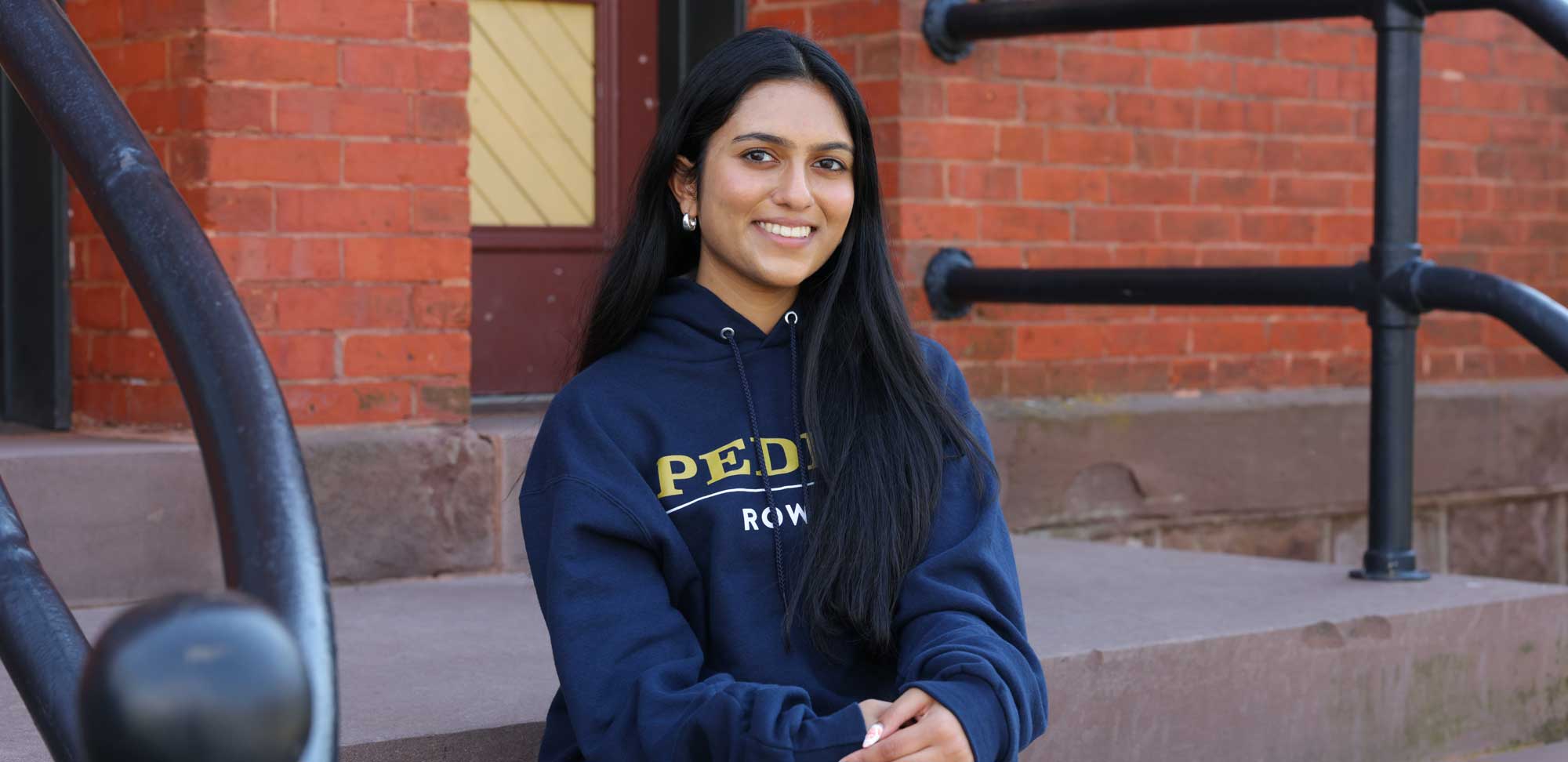
Closing the Gap in Care
How Nikita Goyal ’26 is bringing Alzheimer’s screening to thousands in India.
When Nikita Goyal’s grandmother was diagnosed with Alzheimer’s disease, she had been showing symptoms for some time. She lived in India, where neurological conditions are rarely discussed openly.
“There is just so much stigma,” Goyal recalled. “No one talks about mental health. No one talks about neurological disease, either.”
Her grandmother died soon after the diagnosis. In the months that followed, Goyal found herself returning to a painful question, one that sharpened when she encountered cognitive screenings for the first time.
That moment came early in her high school career, when Goyal began shadowing at a family medicine practice in New Jersey. There, she watched clinicians administer routine cognitive screenings for patients over 65, simple assessments like drawing a clock or recalling details from a short passage.
“I had no clue these existed,” she said. “I couldn’t help but wonder, if my grandmother had access to something like this, would we have been able to find out that she had Alzheimer’s earlier?”
The screenings often led to additional testing, referrals to neurologists and, in some cases, earlier access to treatment and support that could slow the disease’s progression.
Goyal deepened her understanding of neurodegenerative disease through Peddie’s Research Science Signature Experience (STEM EXP), working at Massachusetts General Hospital with neurologist Dr. Rudolph Tanzi, a leading Alzheimer’s researcher.
“He’s incredible,” she said. “He discovered the first gene for Alzheimer’s years ago. He and the people I worked with, they taught me a lot about Alzheimer’s and how the disease develops.”
Taken together, Goyal’s experiences began to clarify a pattern. Early detection and intervention matter.
An estimated 4.1 million people in India live with dementia, yet only a fraction receive a diagnosis or treatment. As the country’s population ages, the number is expected to rise sharply.
Goyal couldn’t ignore the stark contrast between what she’d witnessed at home and what had been absent in her grandmother’s community. She identified the Saint Louis University Mental Status Exam (SLUMS), a low-cost cognitive assessment tool available in more than two dozen languages, and began reaching out to organizations in New Delhi that already operated free medical clinics.
Eventually, two organizations agreed to pilot the screenings: St. John’s Ambulance, which runs clinics throughout New Delhi, and SHEOWS Care Centre, which supports elderly individuals. With these partnerships secured, Goyal formally launched United for Cognitive Health (UCH), a youth-led global health equity initiative focused on early detection and awareness of Alzheimer’s disease in underserved communities.
Through its partnerships with St. John’s Ambulance and SHEOWS Care Centre, UCH has facilitated screenings for more than 5,100 patients in New Delhi, connecting more than 300 individuals to critical treatment. The initiative also offers culturally tailored workshops that encourage families to view memory loss as something worthy of medical attention.
Throughout the process, Goyal’s family has been closely involved.
“It was my dad’s mother who had Alzheimer’s,” she said. “He’s definitely very emotional when we think about it, but I think he’s happy at the end of the day.” Her parents accompanied her to India last year to help ensure the program was running smoothly and to plan for its next phase.
Now a Peddie senior planning to pursue medicine, Goyal continues to advocate for broader access to dementia care. She works with the Alzheimer’s Association of New Jersey, speaking with lawmakers and supporting initiatives such as funding dementia care coordinators for the state.
“I want to study medicine,” she said. “But I don’t want to just do medicine. I want to make a difference in terms of bringing more access to healthcare in general, and not just in India but in America, too.”
She hopes the model she helped build can continue to expand and be replicated elsewhere, ensuring that fewer families confront the uncertainty her own once faced, without answers and without time.